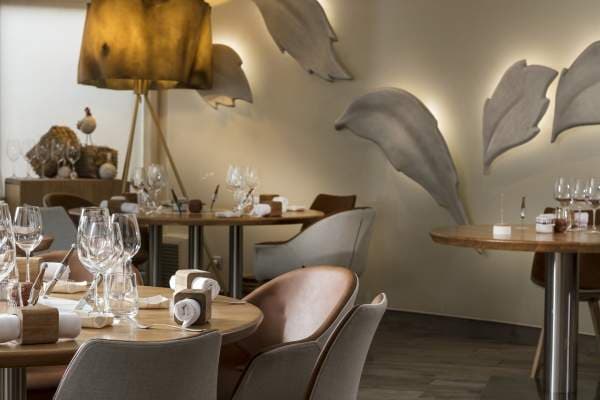
A three-Michelin-star auberge in a stone village of the Corbières, kept by Gilles and Marie-Christine Goujon since 1992 — Meilleur Ouvrier de France in the kitchen, three stars…
La note
A small auberge in a Corbières village of forty houses, kept by the same chef and his wife since June 1992. Three Michelin stars, a Meilleur Ouvrier de France in the kitchen, and the single most photographed egg in French cooking — set on a bed of straw and cracked open to a black bloom of Périgord truffle.
From the editors · Vedere House
Les particularités
Setting
5 Avenue Saint-Victor, Fontjoncouse — a stone village in the Corbières, half an hour west of Narbonne
House
A pale-stone village house — the famous *vieux puits* (old well) is sunk into the floor of the salon under a glass deck
Kitchen
Chef Gilles Goujon — Meilleur Ouvrier de France 1996, trained under Roger Vergé and Jean-Paul Passédat
Floor
Marie-Christine Goujon — dining-room director and the second of the two names above the door
Stars
First Michelin star 1997, second 2001, third 2010 — held continuously since
Awards
Gault & Millau Chef de l'Année 2010 · Chevalier de la Légion d'Honneur 2016 · La Liste — 9th in the world, 2015
Signature
L'œuf de poule « Carrus » pourri de truffes mélanosporum — Périgord truffle egg, mushroom and truffle purée, briochine tiède, cappuccino to drink
Rooms
A small inn opened in 2001 alongside the second star — fourteen rooms in two stone houses on the village square
Best for
A long Corbières lunch from the Aude vines — Narbonne 33 km, Carcassonne 56 km, Perpignan 66 km
Fontjoncouse is forty houses sunk into the Corbières, half an hour west of Narbonne by the slow road through the vines. A Romanesque chapel, a bell tower, the village well at the centre. Gilles Goujon arrived from Bourges by way of Roger Vergé's Moulin de Mougins and Jean-Paul Passédat's Petit Nice and bought the inn on 12 June 1992. He was twenty-nine; Marie-Christine ran the floor from the first day. The first Michelin star arrived in 1997, the second in 2001, the third in 2010 — and the three have not moved since.
“
Le véritable luxe, c'est d'être le gardien d'une région.
”
Gilles Goujon
The kitchen is built around the Languedoc on the door. Iberian pig and Catalan lamb from the Pyrénées foothills, freshwater fish from the Étang de Bages, partridge and game from the Corbières scrub, salt from Gruissan and herbs gathered along the garrigue. Goujon was Meilleur Ouvrier de France in 1996 and Chef de l'Année in 2010; the Légion d'Honneur arrived in 2016. He cooks with the bold hand the title implies — les goûts sont tranchés, où les saveurs s'affirment à chaque bouchée. The single dish that has come to stand for the house is the truffle egg — l'œuf « Carrus » pourri de truffes mélanosporum — kept on the menu since the second star and pricked open at the table over a slow black bloom of Périgord earth.
Lunch begins at twelve-thirty and runs gently into the afternoon. Fourteen rooms wait in two stone houses on the village square, opened alongside the second star in 2001 — the right way, in the end, to take a long Corbières lunch into a long evening and a slow morning back to Narbonne.
Moments choisis
01
A village in the Corbières
Fontjoncouse is a stone village of forty houses in the Aude, sunk into a fold of the Corbières between Narbonne and the Spanish border. A Romanesque chapel, a bell tower, a few rows of pruned vines on the slope behind. Gilles Goujon arrived from Bourges by way of Mougins and Marseille and bought the auberge on 12 June 1992, at twenty-nine; he and Marie-Christine have not left since. *The luxury*, the chef has said, *is being a guardian of one's region.*
02
An egg, a truffle, a bed of straw
The dish that made the house is a single hen's egg — *l'œuf « Carrus »* — set on a bed of dry straw, cooked low, then pricked at the table to a slow bloom of Périgord truffle and earth. A thumbnail of mushroom and truffle purée at the base, a small warm brioche on the side, a thimble of capuccino to drink. Goujon has held the dish on the menu since the second star and would not be persuaded to take it off. Three decades in, it is still the reason a long table books a year ahead in February.
03
The well in the floor
The salon takes its name from the *vieux puits* of the original house — a deep stone well now glazed over and lit from below, set into the floor between two oxblood club chairs. Guests step around it as they cross to the dining room. Above, the room itself is a quiet composition of pale walls, octopus-pleated lampshades and large hand-cut linen leaves lit from behind — a detail Marie-Christine commissioned when the second star arrived. The dining-room note is calm, never showy; the work of the kitchen does the rest.