A 700-hectare regenerative farm in the Serranía de Ronda — nine rooms in a 111-year-old cortijo, ninety Lusitano horses at liberty across the estate, biointensive kitchen gardens,…
La note
A regenerative farm of seven hundred hectares in the Serranía de Ronda — nine rooms inside a 111-year-old Andalusian cortijo, more than ninety Lusitano horses at liberty, biointensive vegetable gardens, a vineyard worked beyond biodynamic, an open kitchen that cooks from all of it. A Relais & Châteaux house run as a manifesto.
From the editors · Vedere House
Les particularités
Setting
Serranía de Ronda, Andalucía — high country between Mediterranean and Atlantic winds
Estate
Around seven hundred hectares of pasture, dehesa, kitchen garden, olive grove and vineyard
Rooms
Nine — Priam, Magnolia, Ana & Adrian, Laura, Sophia, Glass Suite, Deluxe Yurt, Mirto, Piano
House
A 111-year-old cortijo, returned in adobe, stone, wood and lime
Kitchen
Manuel Vargas and Nerea Ortiz de Urbina — open kitchen, full board, almost everything from the estate
Cellar
David Raya — Memoria Líquida from the estate's own Petit Verdot, Blaufränkisch and Garnacha
Stables
Lusitano stud since 2005 — María Culsan and Bernat Barrachina, foals raised at liberty
Best for
A long quiet week of horses, gardens, food from a few hundred metres around the table
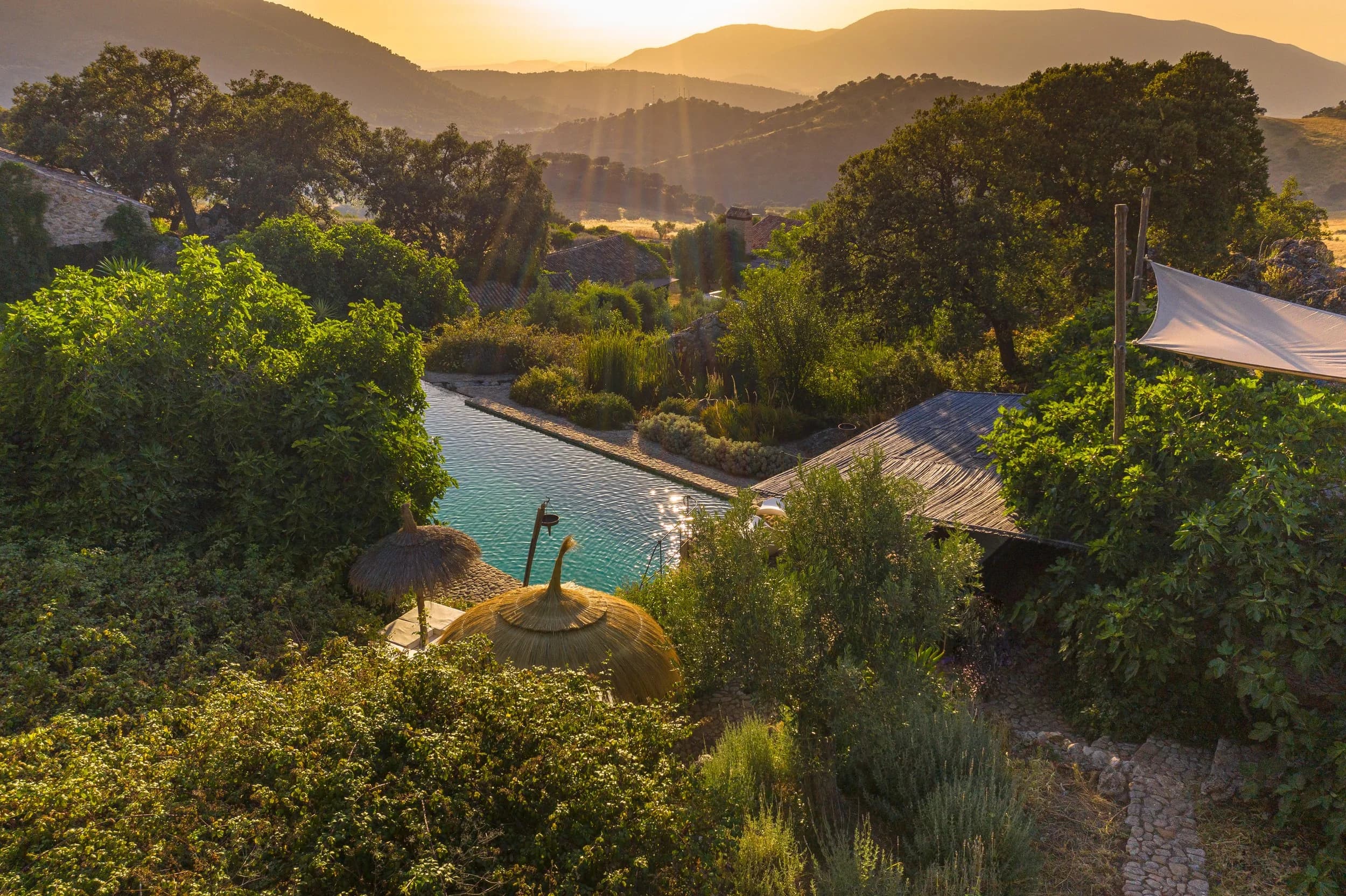
The road to La Donaira leaves Ronda and climbs slowly into a country that does not look like the rest of Andalucía — high pasture, holm oak, the Atlantic wind meeting the Mediterranean over the sierra. The cortijo sits at the top, 111 years old, set back into the hill in adobe and stone. There is a pool cut into the rock, a shaded terrace, a kitchen with an open pass, nine rooms in the main house and the orchard around it.
“
Eating is an agricultural act. The land you sleep on is the land you eat from.
”
Manifesto
The estate runs to seven hundred hectares. Most of it is given to the herd — more than ninety Lusitano horses, born and raised in the field, walked with from the day they stand up. The rest is the working farm: biointensive kitchen gardens, fruit and olive groves, the regenerative vineyard, lambs and Wagyu cattle and bees. The kitchen reads from all of it. Whatever cannot be raised at La Donaira is brought in from a short ring of growers nearby. The wine list begins with Memoria Líquida — the estate's own — and travels out from there.
The pace is the estate's. Mornings in the saddle or in the garden; an hour in the spa, cut into a stone outbuilding behind a curtain of climbers; lunch laid light on a long table; the long Andalusian afternoon; dinner paired with whatever David Raya has decided the night calls for. Stay a week. The country, and the rhythm, take that long to settle.
Moments choisis
01
Ninety horses at liberty
The Lusitano stud was begun on this land in 2005 and now runs to more than ninety horses, living free across seven hundred hectares of mountain and woodland — neolithic country, with cave paintings older than thirty thousand years on the slopes around. Foals are born in the field and stay with their mothers until around three, walked with rather than handled. María Culsan and Bernat Barrachina select for conformation, movement, temperament and long soundness; in 2025 their stallion Elvis took the Spanish six-year-old championship and Seneca LD became World Reserve Champion in conformation.
02
A kitchen that begins outside the door
Manuel Vargas and Nerea Ortiz de Urbina cook from an open kitchen. The vegetables and salads come from the biointensive gardens; eggs and milk from goats and chickens; meat from the estate's lambs, Wagyu cattle, guinea fowl and geese; honey from the estate's bees; oil from its olives; wine from its vines. Whatever the kitchen does not raise itself comes from a small ring of growers nearby. Lunch is light and fresh. Dinner is paired by sommelier David Raya — Spanish bottles for the most part, with the rare and the limited brought up for the night they belong to.
03
Regenerative viticulture, beyond biodynamic
The estate's wines are made under what the house calls regenerative viticulture — past biodynamic, adapted to the warming climate, working the soil first. The cellar holds Memoria Líquida from 2010 to 2016 (Syrah, Cabernet Sauvignon, Cabernet Franc, Petit Verdot) and the newer estate plantings of Petit Verdot, Blaufränkisch and Garnacha. The vines sit at altitude where the Atlantic and Mediterranean winds meet over the Serranía; the bottles are poured by David Raya at dinner, often paired with a story of where the row stands and what it took.