A three-Michelin-star restaurant in the medieval old town of Cáceres, kept since 1986 by Toño Pérez and Jose Polo, with a Mansilla + Tuñón dining room, a circular cellar of forty…
The verdict
A restaurant that two friends from Cáceres opened in December 1986 and have run as a single project ever since. Three Michelin stars, a building by Mansilla and Tuñón that won Spain's National Architecture Prize, and a cellar of forty thousand bottles built around the largest collection of Château d'Yquem in the world.
From the editors · Vedere House
The particulars
Setting
A reimagined sixteenth-century palace on Plaza de San Mateo, in the medieval old town of Cáceres
Architecture
Mansilla y Tuñón — National Architecture Prize, Spain — with the dining room turned to a stone-walled inner garden
Kitchen
Toño Pérez — Extremaduran tradition reread as avant-garde, with Iberian pig, Torta del Casar, foraged herbs and game
Cellar
Jose Polo — forty thousand bottles, twenty countries, ninety-five vintages of Château d'Yquem (five from the nineteenth century)
Format
Single tasting menu, served lunch and dinner — sixteen to twenty courses, around three hours
Best for
A long lunch into the afternoon; a single quiet evening in town
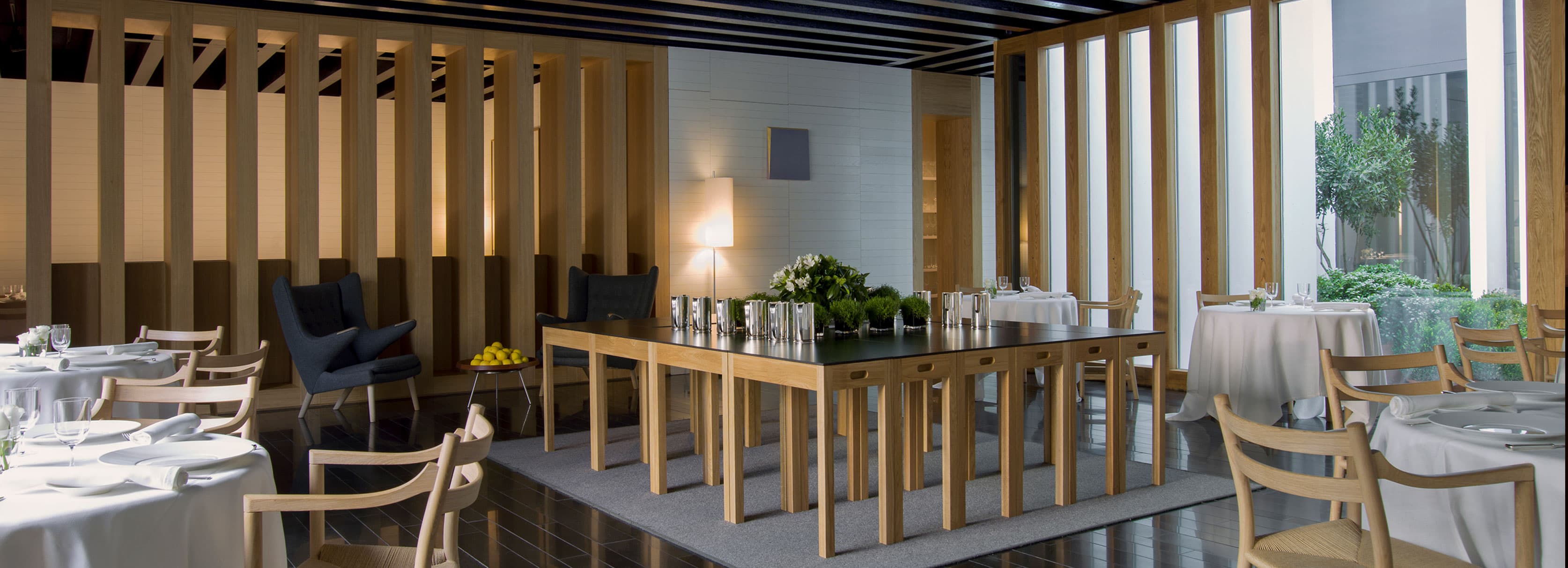
Cáceres is a quiet town on the Portuguese border, walled in pale granite and almost entirely closed against the sun. Atrio sits at the top of it, on the Plaza de San Mateo, behind a door that does not announce itself. Inside, Mansilla and Tuñón have opened the old palace into a single long room of timber fins and full-height glass, turned to a stone-walled garden you can hear before you see — a fountain, a few cypresses, the low call of swifts in summer.
“
Two friends started it in 1986. They have not really stopped since.
”
Sur place
Toño Pérez cooks the country he grew up in. Iberian pig from the dehesa across the valley, Torta del Casar from a farm an hour away, partridge in the manner of Alcántara, jowl flan and aged ham, the dishes named with a child's affection — when our piglet goes to the beach, the indulgent piglet. The single tasting menu runs sixteen to twenty courses; the rhythm is that of a long Spanish afternoon, neither hurried nor slow. The room is quiet. The plates leave the pass at the same temperature they reach the table.
The cellar belongs to Jose Polo and to thirty-six years of slow buying. Forty thousand bottles, twenty countries, every great Bordeaux and Burgundy in their last good vintages. The single obsession is Yquem — ninety-five vintages, the oldest from the eighteen-hundreds, kept along one curving wall in chronological order from the first rose to the deepest amber. Wine Spectator gave the list its Best of Excellence; the better witness is the room itself, circular and silent, lit from a single oculus above the centre. Lunch begins at one. A long table for two takes about three hours.
Signature moments
01
Two friends, since 1986
Toño Pérez and Jose Polo opened the original Atrio in December 1986, in a small room on a side street of the new town. Toño cooked, Jose ran the floor and the wines, and they ran it that way for a quarter-century before moving the restaurant — and themselves — to the medieval old town in 2010. The third Michelin star arrived in November 2022. Thirty-six years between the first table and the third star, the same two names above the door.
02
A dining room by Mansilla y Tuñón
When Atrio moved into Plaza de San Mateo in 2010, Luis Mansilla and Emilio Tuñón opened the old palace into a single composition — pale stone, dark steel, vertical timber fins, full-height glass turned to an interior garden. The room is the same width as the table-cloths and the same length as a slow afternoon. The building took the National Architecture Prize the year it opened.
03
A cellar built around Yquem
Below the dining room sits a circular cave of pale wood — forty thousand bottles from twenty countries, ringed around a single oculus. Romanée-Conti, Pétrus, the four First Growths of the Médoc, Haut-Brion. The centrepiece is the largest collection of Château d'Yquem in the world — ninety-five vintages, five from the nineteenth century, sixty-seven from the twentieth, four from the twenty-first. Wine Spectator gave the list its Best of Excellence award. Jose Polo built it, and pours from it, himself.